Enterprise Design in 2026
Over the last few months, my design workflow hasn't just improved. It has fundamentally shifted -- not because I abandoned research, but because the cost of execution collapsed.
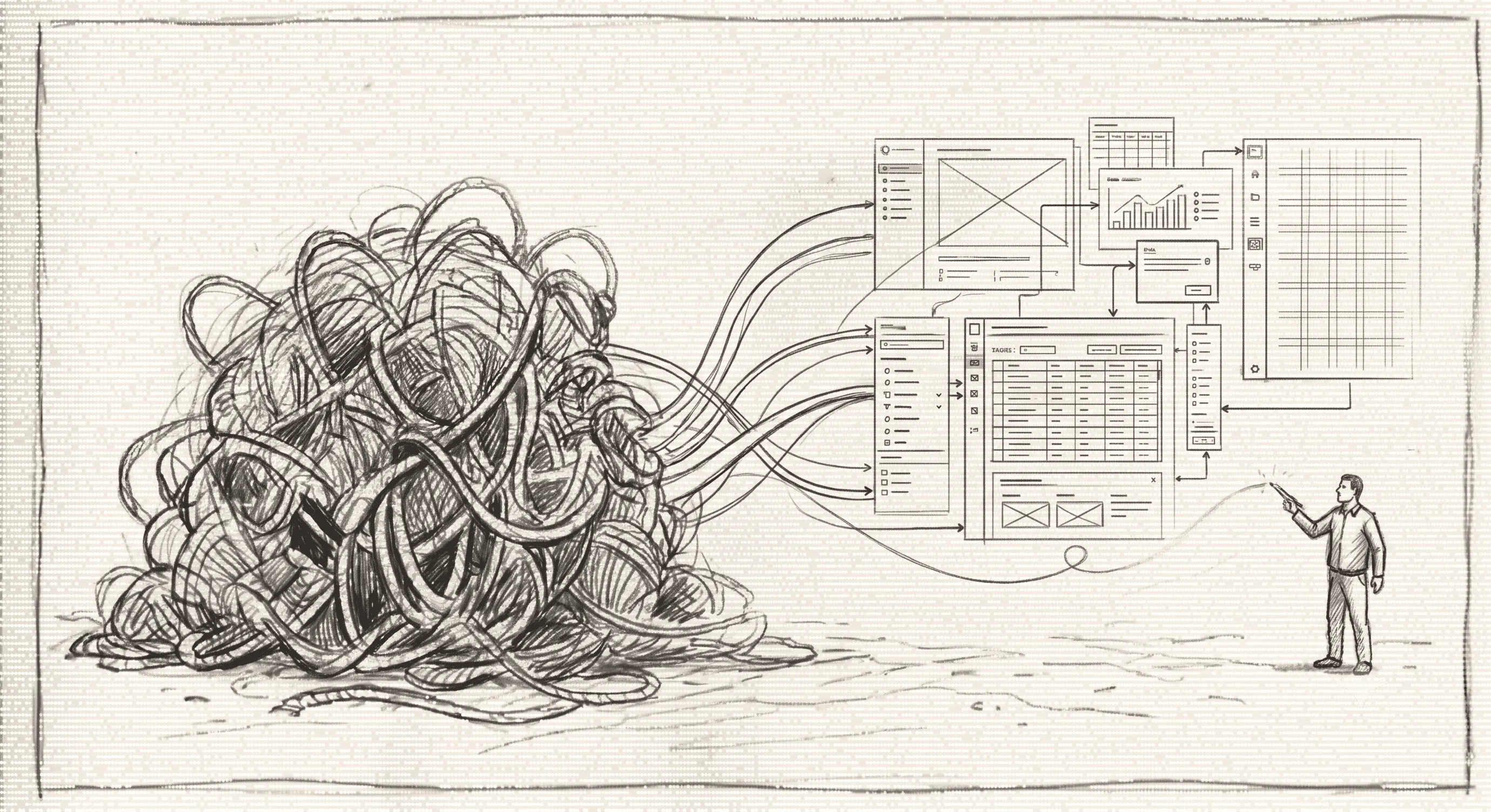
Over the last few months, my design workflow hasn’t just improved. It has fundamentally shifted.
Not because I abandoned research. Not because design tools are irrelevant. But because the cost of execution collapsed, and that changes everything.
Earlier, enterprise design followed a predictable arc. You received a problem, immersed yourself in the domain, mapped current processes, identified pain points, defined the future state, then moved into wireframes, high-fidelity screens, and eventually a prototype. Six to eight weeks for a meaningful milestone wasn’t unusual.
A large portion of that timeline wasn’t deep thinking. It was manual production. Drawing predictable enterprise UI patterns so stakeholders could imagine what the system might eventually feel like.
The thinking was slow. The rendering was slower.
Now the sequence is different.
I still begin with ambiguity. I map the as-is flow, document constraints, understand guardrails, and clarify what problem we’re actually solving. I use the infinite canvas heavily at this stage because it’s still the best surface for untangling messy systems and aligning human context.
That hasn’t changed.
What changed is what happens after clarity.
Instead of manually designing every screen, I move into agentic prototyping. I build the full vision — not a trimmed MVP, but the advanced, complete solution — with working logic, realistic content, backend integration, and usable flows.
And this happens in days.
When stakeholders see a functional system instead of static screens, the conversation shifts from imagination to evaluation. They don’t ask what it might do. They test what it does. They expose edge cases. They challenge assumptions grounded in behavior rather than visuals.
Feedback becomes sharper because the artifact is real.
Enterprise constraints still shape delivery. Phases, compliance, data dependencies, and budget realities don’t disappear. So we begin with the full possibility space, and then we carve it down responsibly. What belongs in Phase 1? What is feasible now? What must wait?
The difference is that we’re slicing something that already exists, not debating hypothetical wireframes.
Meetings have changed too. Earlier, long stakeholder calls meant execution paused. Now, when a change is proposed, I can scaffold it immediately with an agent. After the call, I review and refine. Updated link goes out the same day.
The lag between conversation and artifact has nearly vanished.
That lag used to define design.
Developers feel the shift as well. When they see a working prototype with structured logic and integrated flows, they don’t interpret static intent. They refactor something real. They productionize instead of translating. Ambiguity drops significantly.
It’s important to clarify something here: Figma is not dead in this process. It has simply returned to its actual strength.
I still use the canvas to think slowly. To map ambiguity. To structure process. To align context before touching agents. I also archive major iterations in Figma Design — V1, V2, V3 — not for aesthetics, but for decision traceability. When someone asks why something changed weeks later, the reasoning history exists.
Once direction stabilizes, I refine the system manually in Figma — spacing rhythm, typography scale, layout density, component variants. Then I feed that structured design language back to the agent so consistency propagates across the product.
In this workflow, I design the grammar. The agent writes the sentences.
What disappeared wasn’t research. It wasn’t systems thinking. It was manual repetition of predictable UI scaffolding. Enterprise interfaces follow patterns: navigation rails, data dashboards, filters, tables, charts, chat layers. If that structural layer can be generated in days instead of drawn for weeks, there’s little reason to cling to the older production cycle.
The differentiation no longer lies in pixel polish alone. It lies in how problems are framed, how constraints are defined, how guardrails are enforced, how systems evolve over time, and how delivery phases are structured without breaking long-term architecture.
Execution is no longer the bottleneck.
Clarity is.
The cognitive texture of the work has changed as well. Earlier, I would immerse deeply in one problem for weeks. Now I orchestrate multiple streams in parallel — prompting, refining, validating outputs, correcting assumptions, translating machine reasoning into stakeholder-safe articulation, integrating backend systems.
The work feels less manual and more supervisory. The load didn’t decrease. It shifted.
We are moving from designers as artifact producers to designers as system shapers operating inside executable environments.
That shift is subtle, but it’s happening.
And it changes where our energy goes.