Design didn't change. The cost of execution did.
Something has been quietly shifting in how design work actually gets done. Not in the fundamentals -- in the cost of acting on a decision.
Over the last few months, something has been quietly shifting in how design work actually gets done. It’s not dramatic on the surface, and nothing in the fundamentals of design has really changed. We still talk about users, problems, flows, constraints, and systems the same way we always have.
But the way we execute those ideas has changed significantly.
What used to take weeks — wireframes, high-fidelity screens, prototypes — can now be generated in hours. Not perfectly, not production-ready, but good enough to start real conversations with stakeholders and teams. And that alone starts changing the dynamics of how design is valued.
Because when execution becomes faster and cheaper, the importance of execution itself starts to reduce.
For a long time, designers were valued for their ability to produce artifacts. Clean screens, structured layouts, well-defined components, polished flows. A lot of effort went into creating these outputs, and that effort itself justified the process.
Now that effort is getting compressed.
You can still design everything manually, and many people will continue to do so. But the expectation around time and output is slowly shifting. When one designer can produce something usable in two days and another takes three weeks to reach the same point, the conversation naturally changes.
It’s no longer just about how good the design looks. It starts becoming about how quickly something can be made real.
And once that shift happens, things get uncomfortable.
Because when tools become widely accessible, even speed stops being a differentiator after a point. What felt like an advantage quickly becomes the baseline. And that’s when the real question starts to surface.
If everyone can generate good UI, then what actually matters?
This is where a gap begins to show.
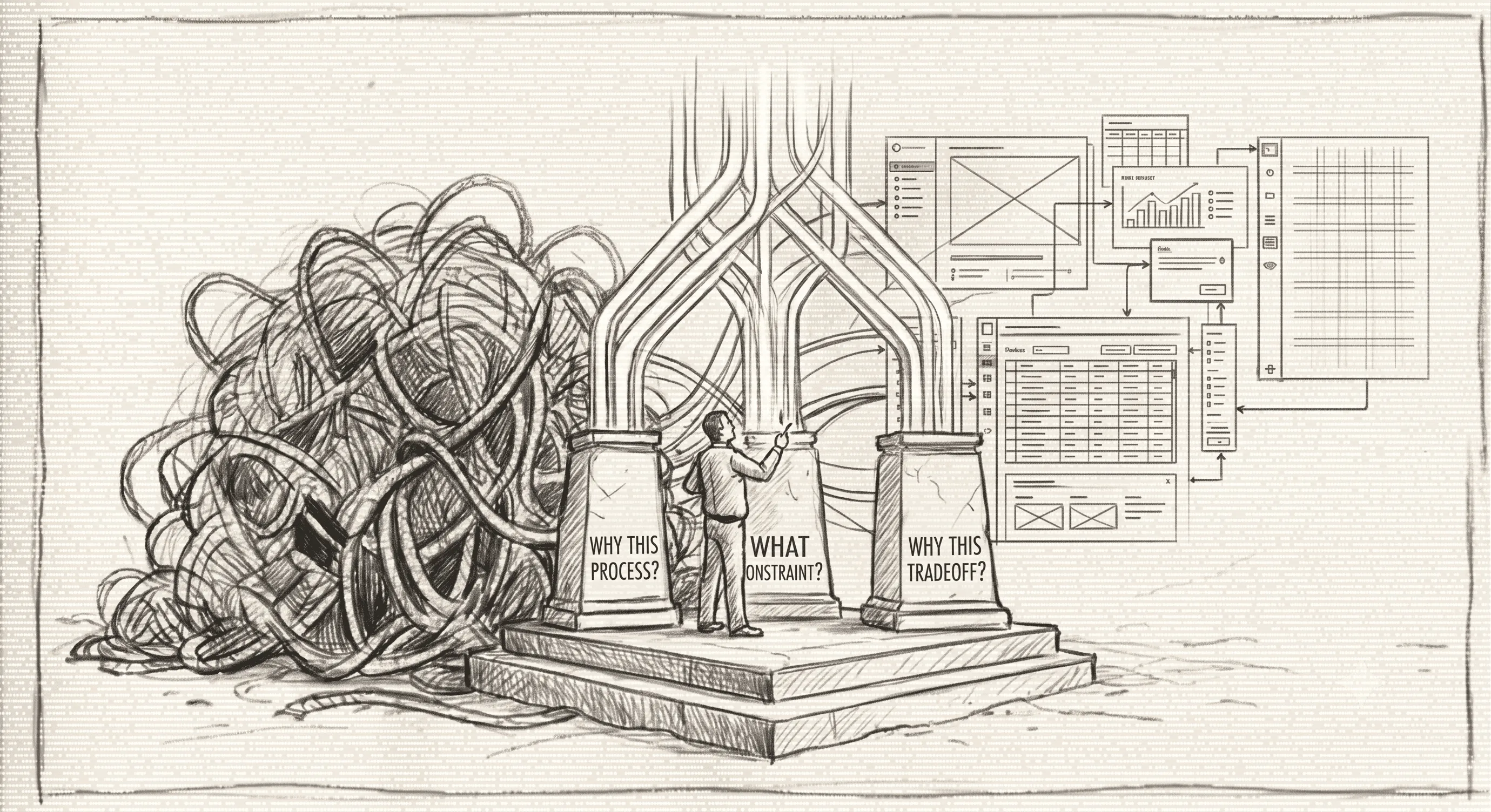
You start noticing designers who can create visually strong screens but struggle when asked why something exists the way it does. Why this flow? Why this structure? Why this tradeoff? What constraint is being solved here?
Earlier, this gap wasn’t very visible. The effort required to produce the UI itself was high enough that the output carried weight on its own. Now that the effort is reducing, the thinking behind the output is becoming more visible.
And that’s where most of the current anxiety is coming from.
It’s not really about AI replacing designers. It’s about AI exposing which part of the work was actually valuable.
AI systems are very good at generating answers. If you give them direction, they can produce layouts, flows, components, even working interfaces. But they don’t understand messy context.
They don’t know which stakeholder actually has decision-making power. They don’t understand internal team dynamics. They don’t know when research is misleading or incomplete. They don’t recognize when a solution is over-engineered for the problem it’s trying to solve.
They can generate structure, but they don’t truly judge context.
That part still depends on the designer.
Which means the role itself doesn’t disappear. But it does shift.
Instead of focusing primarily on producing screens, the work starts moving toward shaping systems. Instead of drawing layouts, it becomes more about defining behavior. Instead of spending most of the time on execution, the focus moves toward clarity.
And clarity is slower, harder, and far more valuable.
Because clarity is what determines what should be built, what should be ignored, what should be simplified, and what should not exist at all. Execution simply follows those decisions.
If you look at most real-world products, especially in enterprise environments, the complexity is not in the UI itself. It exists in the data relationships, business rules, permissions, edge cases, and process flows that sit underneath. The UI is just the surface where all of that complexity becomes visible.
And that surface is now easier than ever to generate.
So the leverage naturally moves below the surface.
This is also why many designers feel stuck right now. They are getting access to faster tools, but they are still operating at the same level of thinking. As a result, instead of feeling empowered, they start feeling replaceable.
Because the thing they were optimizing for is no longer scarce.
The uncomfortable truth is that this shift can be ignored for a while. You can continue designing the same way, continue producing high-quality screens, and continue following familiar processes.
But slowly, the market starts rewarding something else.
Not just better UI, but better thinking. Clearer problem framing. Stronger judgment. Faster translation of ideas into something real and testable.
And that shift is already visible if you pay attention.
The designers who are adapting are not necessarily the ones creating the most visually impressive screens. They are the ones who can take a messy, unclear problem, structure it properly, and turn it into something tangible very quickly.
Not perfect, but usable enough to gather real feedback.
Because once something becomes real, feedback becomes real. And that shortens the entire product loop in a way that static design never could.
This is where design seems to be heading.
Not toward disappearing, but toward operating at a different level.
And I think most designers haven’t fully internalized that yet.