Transforming Enterprise: Untangling Process
Every enterprise AI project starts with the same delusion. The kickoff deck shows a straight line. Reality is the tangle.
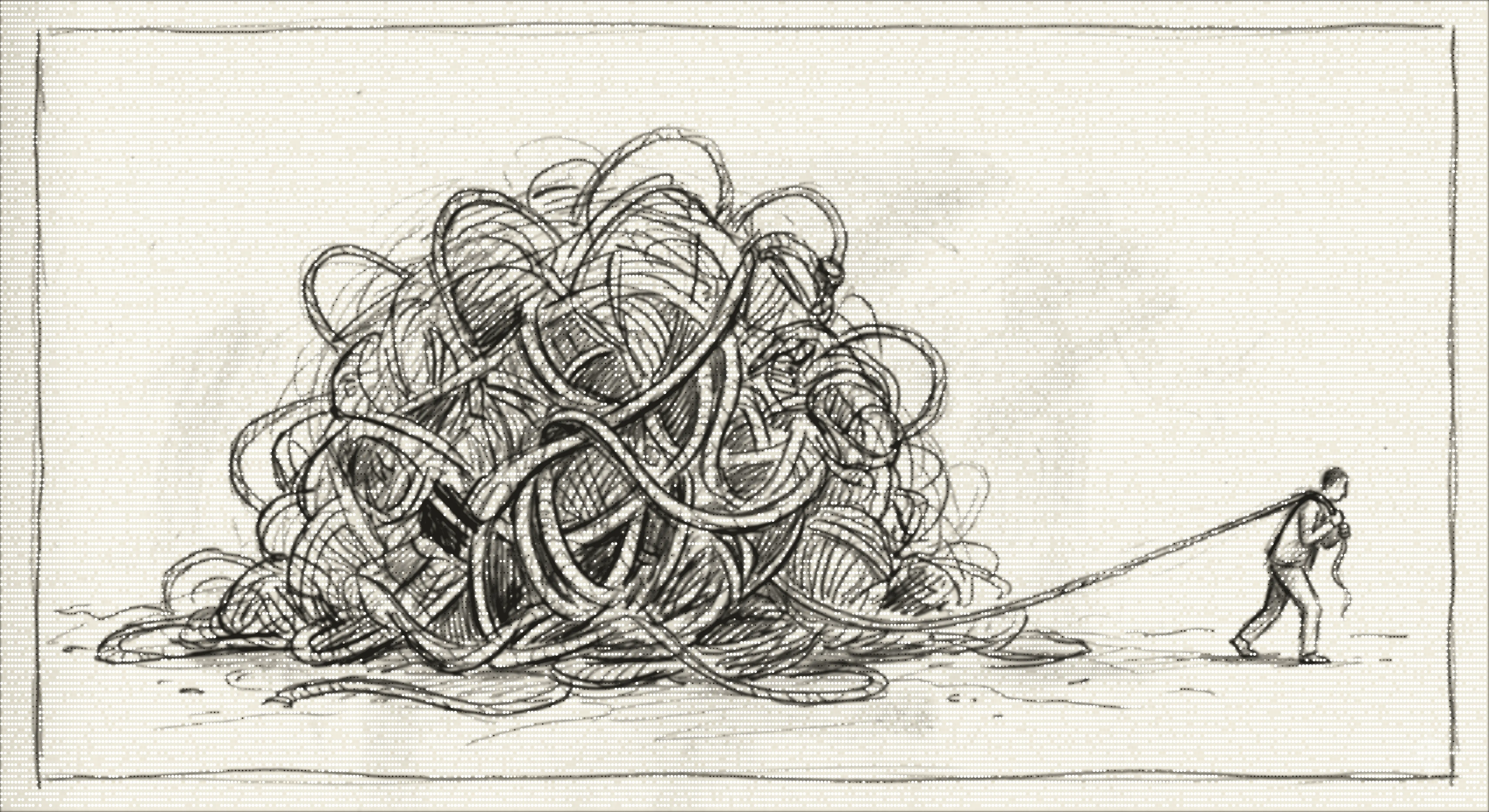
Every enterprise AI project starts with the same delusion.
The kickoff deck always shows a straight line. The mandate is simple: map the current legacy flow from the Standard Operating Procedures (SOPs), identify the pain points, drop an AI agent into the high-friction touchpoints, and add a human-in-the-loop for final review.
Simple, right?
But enterprise software doesn’t run on straight lines. It runs on a tangled wire of hundreds of undocumented edge cases buried inside a single step. The SOP is fiction. And if you design for the SOP, your product will fail on day one.
The Interview Trap
The problem starts at step one: mapping the “As-Is” flow. You sit down with the Subject Matter Experts (SMEs) — veterans who have kept the company running for decades — and you ask the logical question: “How do you do this?”
This is your first mistake.
You cannot ask someone with 20 years of experience to linearly explain their job. To them, the complex is obvious. They operate entirely on muscle memory and instinct. If you ask them how a process works, they will recite the sanitized, happy-path version of the SOP because they don’t even realize they are doing the mental gymnastics required to navigate the edge cases.
If you just ask questions, you get textbook answers. To get the truth, you have to stimulate friction. You have to nitpick their thoughts and force them into a corner where they say, “Well, in that specific scenario, I actually ignore the dashboard, ping the lab director, and manually check the legacy database.”
To get those answers, you have to challenge their reality. You have to show them something wrong.
Designing for Provocation
In the age of AI, generating a “wrong” prototype is your greatest point of leverage.
You don’t need to spend three weeks wireframing in a silo. You take your domain assumptions, map the flow according to the official SOP, and ask your AI to identify the automation touchpoints. You convert that into a PRD.
Then, you open Figma Make, Lovable, Bolt, v0, Claude Code, Codex or Cursor. You paste it in.
Within minutes, you have a functional, high-fidelity first draft. It is highly polished, beautifully agentic, and completely inaccurate to how the business actually operates. That is exactly what you want.
Halfway through the SME interview, you stop asking abstract questions. You put the assumed solution on the screen and let them interact with it.
The dynamic instantly fractures. Now, they have something to compare their current world against. They see their domain represented incorrectly, and human nature takes over. They will instantly correct you. “No, no, it doesn’t work like this. Instead of this module, we actually need the compliance tags here, and we do X before Y.”
They give you the edge cases you would have never uncovered from a sterile interview script. You use AI generation not as a final output, but as a crowbar to extract human reality.
The Dark Reality of the “Approved” Concept
You take that feedback. You go deep into the “what ifs.” You connect with other SMEs, refine the draft, and stress-test it with your engineering leads. You present it again.
This time, they nod. The concept is approved. The stakeholders love the vision of this seamless, automated future.
And that is when you uncover the dark reality of enterprise transformation.
Your proposed solution is a ghost. It is a brilliant piece of system design that will only ever work in your prototype.
Why? Because you designed an AI agent that seamlessly answers questions, cross-references approvals, and fetches historical context. But when you finally look under the hood of the enterprise architecture, you realize there is no central repository. There is no unified Knowledge Graph.
The data your beautiful agent needs to fetch is scattered across fifteen fragmented legacy databases, three different third-party vendors, and a rogue Excel macro from 2018.
The interface is approved, but the backend is a void.
This is the hard truth of transforming legacy enterprise. Designing the automated workflow is the easy part. But you cannot agentify a system that doesn’t know where its own data lives.
Your job as a designer isn’t just to untangle the process on the screen. It is to map the tangled wire all the way down to the data layer, and force the business to confront the reality of what it actually takes to build the future.